LED Phototherapy in an Aesthetic Practice: How to Integrate It into Protocols
Lorema Estetic
An LED panel often enters the treatment room with a good idea but no clear workflow. It is switched on at the end of an appointment “to enhance the result,” offered as a separate session or set to the same colour for almost every client.
Used this way, the device may create a pleasant experience without becoming a meaningful professional tool.
Phototherapy can serve a specific purpose: preparing the skin, supporting recovery, maintaining continuity between intensive treatments or forming a standalone course. The practitioner needs to understand the objective, dose, treatment sequence and limitations.
How LED phototherapy works
LED treatment is associated with photobiomodulation. Light-emitting diodes produce selected spectral ranges, while the response depends on wavelength, irradiance, fluence, treatment duration and delivery mode.
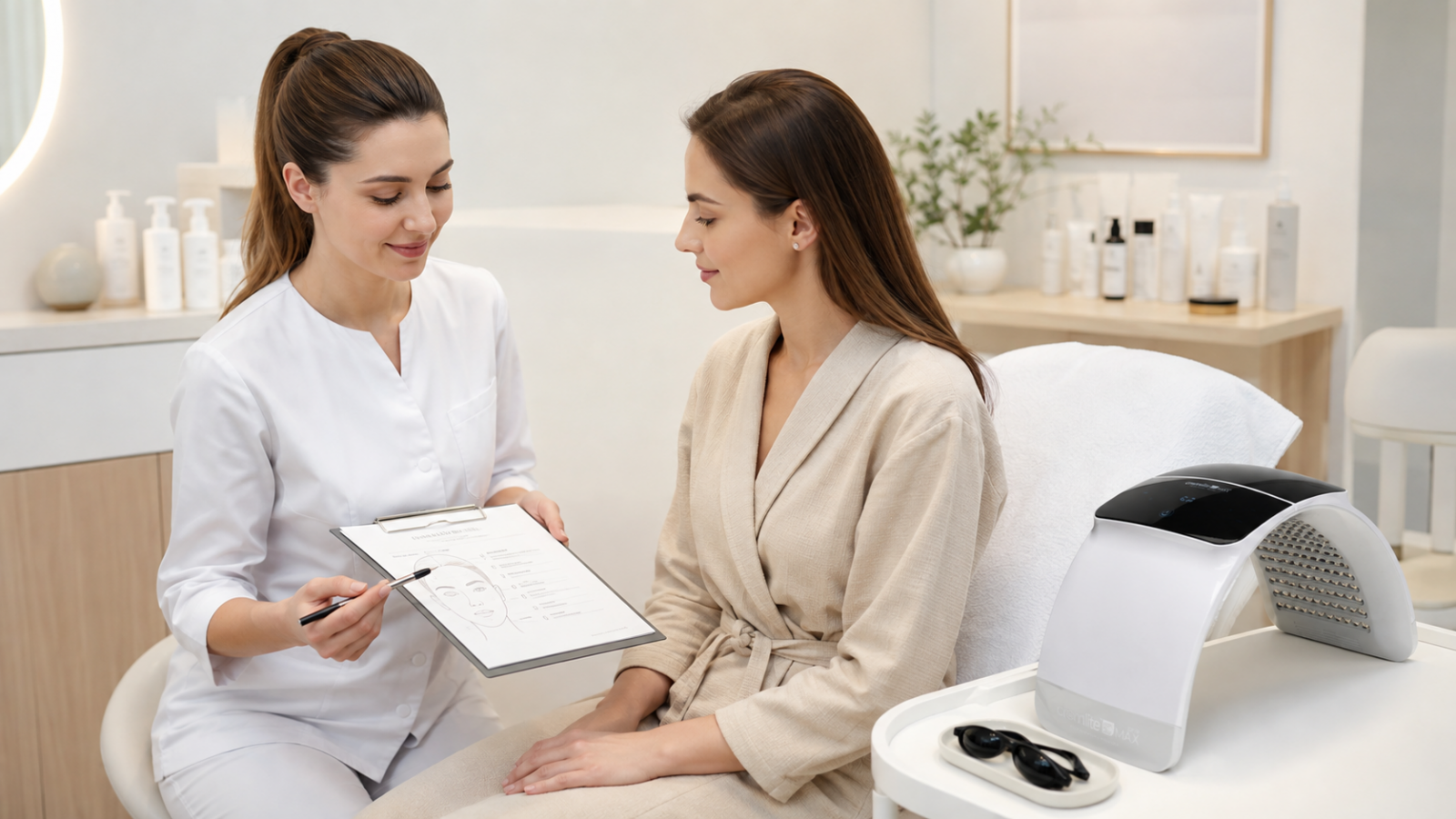
FDA guidance defines photobiomodulation as the application of light at an irradiance that does not induce heating, with the aim of altering biological activity. It also notes that outcomes depend on wavelength, fluence, irradiance, pulsing parameters and treatment area. See the FDA guidance on photobiomodulation devices.
This differs from ablative lasers and IPL systems designed to generate heat or controlled tissue injury. LED does not replace resurfacing, chemical peels or microneedling. Its value lies in gentle standalone care and thoughtful integration with other treatments.
Why colour alone is not a protocol
“Blue for acne, red for rejuvenation” is easy to remember but incomplete.
The delivered dose depends on:
-
exact wavelength;
-
irradiance;
-
distance from the skin;
-
exposure time;
-
continuous or pulsed delivery;
-
uniformity of coverage;
-
treatment frequency;
-
skin phototype;
-
barrier condition;
-
products used during the appointment.
Longer treatment does not automatically produce a better result. A review of photobiomodulation parameters highlights the need to consider wavelength together with power, dose, duration and repetition.
How different light ranges are used
Blue light
Blue light is commonly included in protocols for skin with inflammatory acne lesions. Combined blue and red LED phototherapy has been studied in acne care, although it does not replace dermatological assessment or treatment. See the clinical study of blue and red LED therapy.
Red light
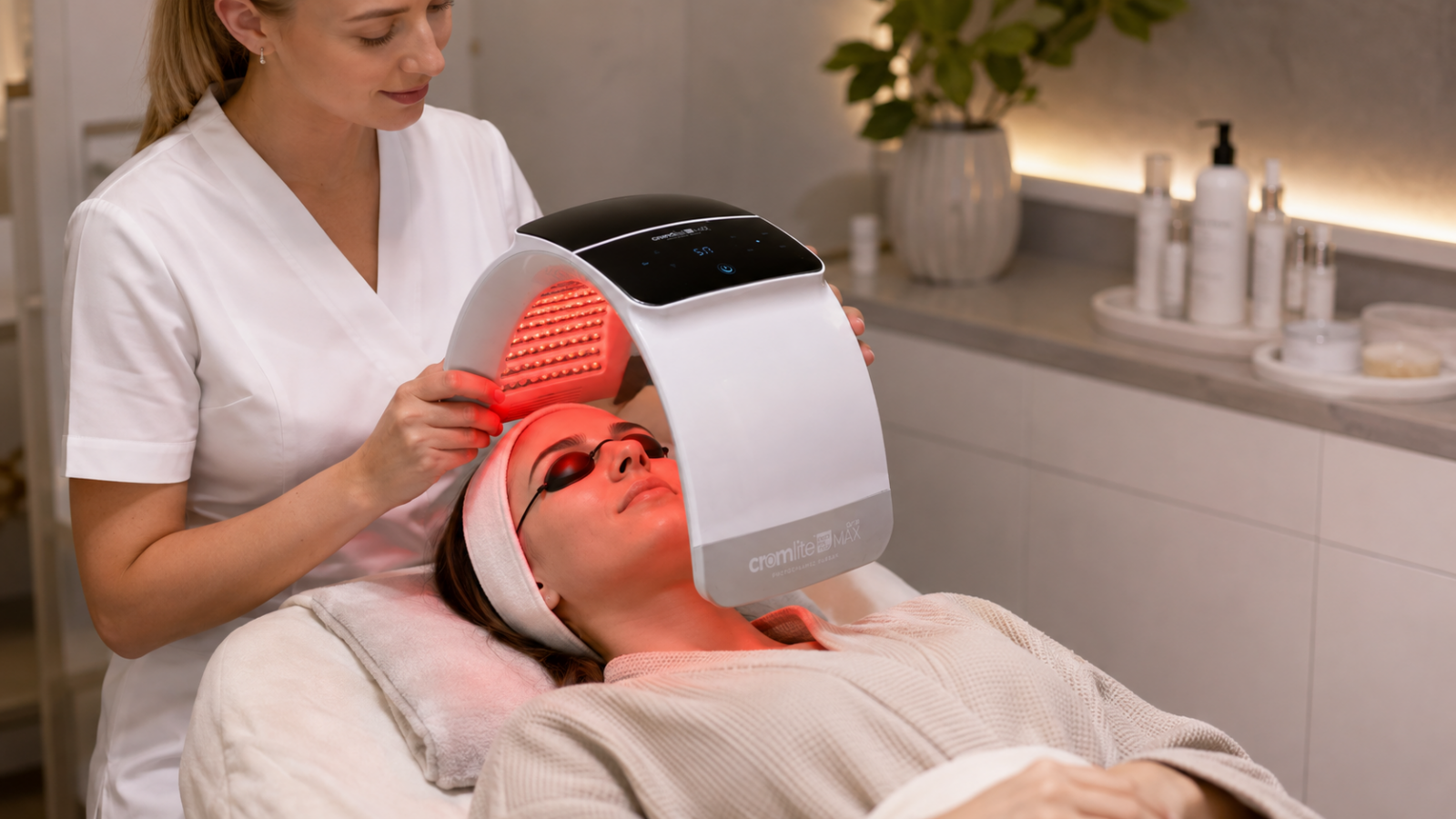
Red light is widely used in photobiomodulation and skin-ageing programmes. Red and near-infrared wavelengths have been studied for the visible appearance of skin texture and fine lines, with outcomes assessed over a treatment course. See the clinical study using 633 and 830 nm LED phototherapy.
Near-infrared light
Near-infrared wavelengths penetrate more deeply than visible red light and are used in selected PBM programmes. Greater depth does not justify arbitrary increases in intensity or treatment time.
Green and yellow programmes
Green and yellow options are included in many professional systems for tone-focused, redness-focused or comfort-oriented protocols. Evidence differs between spectral ranges, so device specifications and manufacturer guidance should take priority over colour-based marketing.
Four ways to integrate LED into a protocol
1. Before the primary procedure
A preparatory LED session may be appropriate:
-
within a programme for reactive skin;
-
before an intensive treatment course;
-
to assess tolerance to light exposure;
-
as a gentle visit between consultation and the next procedure.
It should not be claimed that LED automatically “opens pores” or drives every product deeper into the skin.
2. After the primary procedure
One of the clearest roles for LED is as a finishing stage after a compatible treatment.
Small studies have evaluated photobiomodulation after fractional laser procedures and reported faster improvement in post-treatment erythema. These findings should not be applied automatically to every device. See the study of LED after fractional laser treatment and the study following fractional CO₂ resurfacing.
LED may be considered after:
-
gentle professional cleansing;
-
selected non-invasive device treatments;
-
compatible superficial peels;
-
approved fractional protocols.
After microneedling, ablative lasers or stronger peels, the practitioner must assess the barrier and confirm product compatibility before adding light exposure.
3. Between intensive treatments
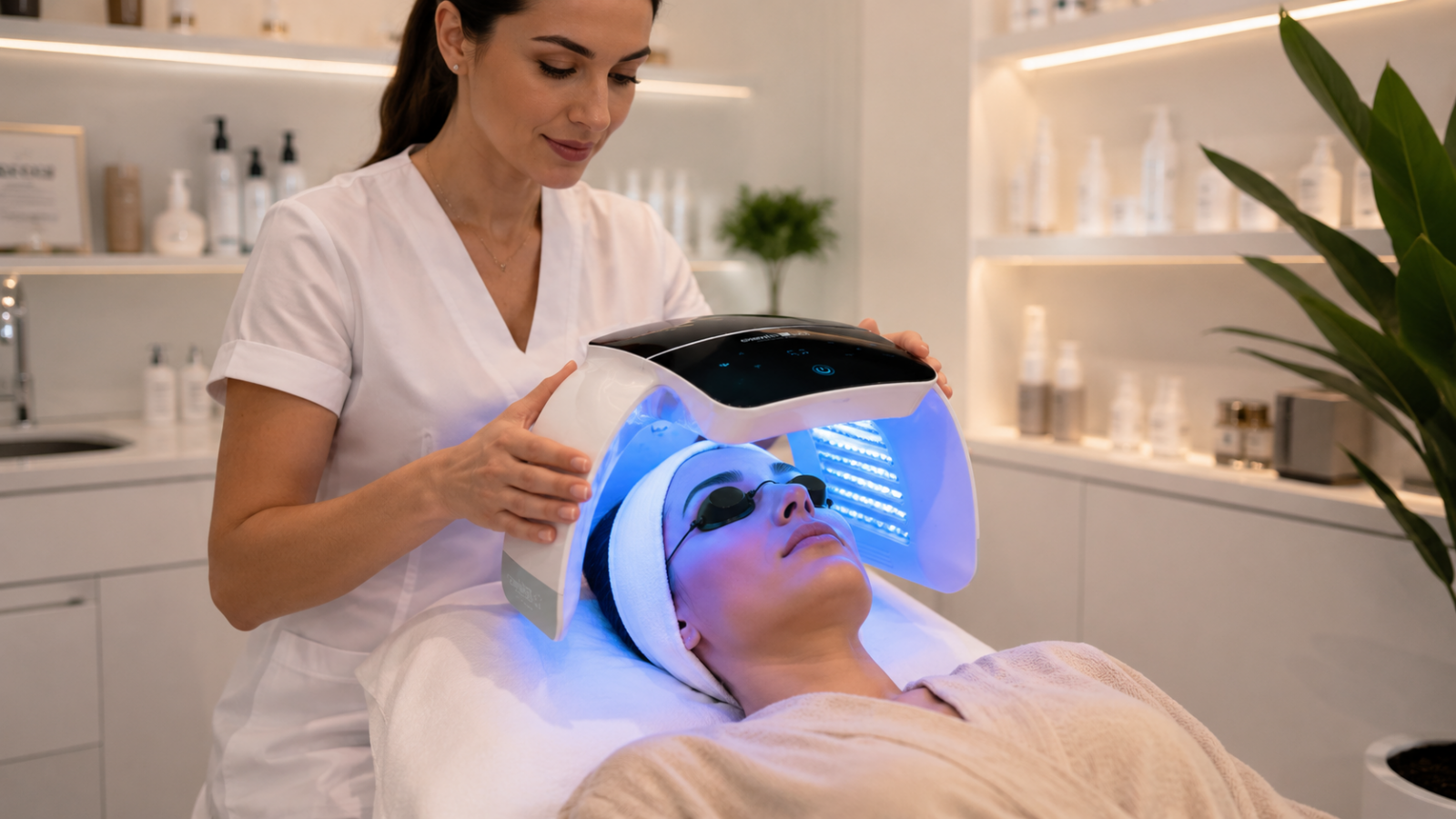
LED can support continuity between peels, lasers and microneedling sessions.
A maintenance appointment may include:
-
Reassessing the skin.
-
Gentle cleansing.
-
An LED programme matched to the current goal.
-
Moisturising and protective care.
-
Deciding whether the skin is ready for the next primary treatment.
Settings should be reviewed whenever medication, skincare or skin condition changes.
4. As a standalone facial light therapy service
A standalone course can suit clients who prefer non-invasive care without significant downtime.
The practitioner should explain that:
-
progress is usually assessed over several sessions;
-
outcomes depend on the starting condition;
-
LED does not replace medical acne treatment;
-
it does not substitute for vascular lasers, scar procedures or pigment-specific devices.
Practical protocol examples
Acne-prone skin
-
Assess the skin and refer medical forms of acne.
-
Cleanse gently.
-
Use an approved blue or blue-red programme.
-
Apply neutral finishing care.
-
Plan the course and home routine.
A finishing stage after treatment
-
Complete the primary procedure.
-
Assess the immediate response.
-
Check product compatibility.
-
Use an approved red or near-infrared programme.
-
Record the settings and response.
A maintenance visit
-
Review recovery.
-
Cleanse gently.
-
Select LED according to the current objective.
-
Moisturise and protect.
-
Plan the next primary appointment.
How to choose a professional facial LED device
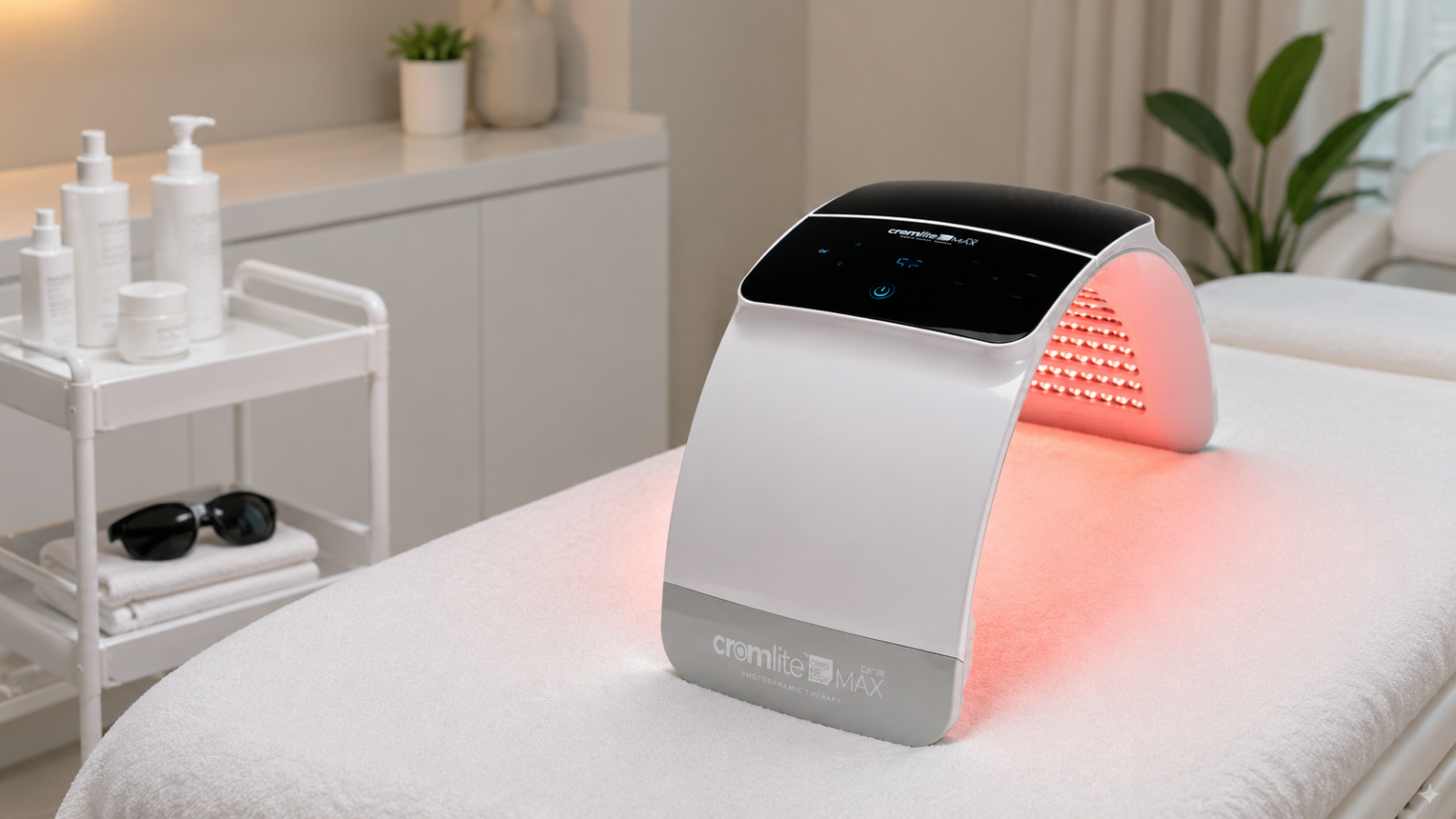
The number of colours should not be the main purchasing criterion.
Evaluate:
-
verified wavelengths;
-
diode placement;
-
coverage uniformity;
-
working distance;
-
programme control;
-
eye protection;
-
cleaning and disinfection;
-
training and technical support.
The CROMLITE MAX Ca2+ IR LED phototherapy lamp combines visible wavelengths of 415, 560, 590 and 635 nm with 850 nm infrared light. Its product page lists 63 programme options and session lengths of 15–60 minutes, supporting standalone, preparatory and finishing formats.
Safety screening
Before treatment, review:
-
photosensitivity;
-
photosensitising medication and skincare;
-
active infection or broken skin;
-
unexplained lesions;
-
device-specific contraindications;
-
suitable eye protection.
FDA information notes the importance of eye protection and cautions around photosensitivity, photosensitising medication, active infection and lesions in the treatment area. See the FDA information on photobiomodulation and light-based technologies.
How to position LED on the service menu

LED can be offered as:
-
a standalone course;
-
an add-on after a compatible procedure;
-
a maintenance session;
-
part of a combined programme.
Clients understand “supportive care for acne-prone skin” more easily than “20 minutes of blue light.” The service should be framed around its purpose rather than the colour of the panel.
The LorEmA Estetic basic cosmetology course covers skin assessment, safety and device-based methods, helping practitioners build combined protocols with clearer professional reasoning.
FAQ
Can LED be used after every procedure?
No. Compatibility depends on the skin barrier, products applied, the primary procedure and device instructions.
Which light is best for the face?
There is no universal best wavelength. Selection depends on the treatment goal and device parameters.
Can LED be combined with a chemical peel?
It can be considered in compatible protocols after reviewing peel depth, skin response and photosensitising ingredients.
Does LED require a treatment course?
Many aesthetic goals are assessed over several sessions. Frequency depends on the device and the client’s response.
Does LED treat acne?
It may complement selected acne protocols, but it does not replace dermatological diagnosis and treatment.
How should a clinic choose an LED device?
Look at wavelengths, coverage, programme control, safety features, training and technical support rather than colour count alone.
LED is most valuable when its role is clear
LED phototherapy should not be a random lamp switched on at the end of an appointment. It becomes a professional tool when the practitioner knows why it is being used, which parameters are selected and how the skin response will be evaluated.
Beauty professionals and clinic owners in Moldova can explore the CROMLITE MAX professional LED system and consult LorEmA Estetic about integrating phototherapy into the service menu and training the team.
